The Intergalactic Fermi Problem
The headwaters of the Fermi Paradox channel directly through Michael Hart and Frank Tipler, and it’s a testament to the power of their arguments that this remains true today. It was Hart who in “An Explanation for the Absence of Extraterrestrials on Earth” (published in the Quarterly Journal of the Royal Astronomical Society in 1975) pointed out something blindingly obvious once stated. Moving at one-tenth of the speed of light, a civilization could send its probes throughout the galaxy in as little as 650,000 years.
Hart set an upper limit on this at 2 million years, but either way the point resounded in the astrophysics community because these are tiny time spans compared to the age of the universe. Hart even factored in a pause after each leap to a new star to found a ‘colony,’ or whatever such a probe would do there. Our Sun being a relatively youthful 4.6 billion years old, that was a vast amount of time for earlier civilizations to have mastered technologies opening up trips to the stars, but we have yet to find evidence of them.
The ‘Where are they?’ question resonated with Tipler when he picked up John von Neumann’s idea of self-replicating probes. Tipler pointed out that this wave of replication would be unstoppable. The fact that we saw no evidence of it led to the title he chose for his paper: “Extraterrestrial Intelligent Beings Do Not Exist,” which was published in 1980 in the Quarterly Journal of the Royal Astronomical Society. It quickly led to spirited argument in the pages of Physics Today and continues to motivate debate.
It would be fun sometime to go through that early back and forth, which included Frank Drake, Carl Sagan, Gregory Benford and William Newman, but I’ll fight off my digressive instincts to home in on the paper I want to talk about today. It’s from David Kipping, and takes Hart and Tipler’s ideas a logical step further. If we can extrapolate a ‘filled’ galaxy within 650,000 years (and Kipping points out that this number continues to look viable), then what about galactic expansion? After all, intergalactic travel times should be endurable for machine intelligence. Should we expect signs that other galaxies – perhaps all galaxies — should have been ‘infected’ by self-replicating technologies by now?
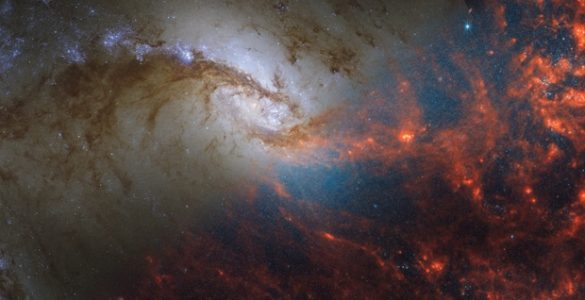
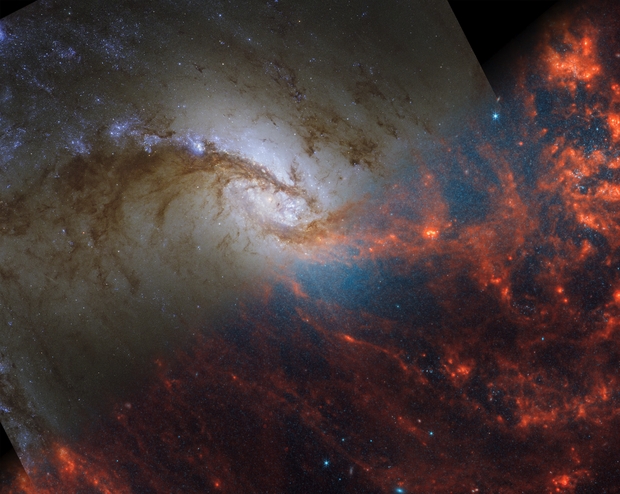
Image: Could it be that entire galaxies are infested with self-reproducing technologies? This one is the barred spiral galaxy NGC 1365, split diagonally in this image: The James Webb Space Telescope’s observations appear on bottom right, and the Hubble Space Telescope’s at top left. David Kipping’s new paper examines how we can extend the Hart-Tipler argument on the expansion of technologies through one galaxy into cosmological realms. Credit: NASA, ESA, CSA, STScI, PHANGS Team, Janice Lee (STScI), Thomas Williams (Oxford).
All of this raises the question of what a self-reproducing probe would be likely to do to a planet it encounters. It is striking that we don’t have to assume bad intent on the part of the builders. If self-reproducing probes built by civilizations far ahead (technologically) of our own are simply sent out as scouts and explorers, over the course of aeons some may begin to spawn destructive offspring simply because of the gradual introduction of errors into their programming. These in turn reproduce. From this we get the concept of the ‘berserker’ probe that destroys worlds.
Or perhaps, as Kipping muses, they simply go about converting planets into computational substrate. Modern developers pay no attention, for example, to the survival of small creatures in the landscape they ravage to build new apartment houses. Whether such a probe would notice a fledgling technological civilization or not is a matter of debate. But let’s look at that idea of infection. It is not intended to imply the malignant spread of anything. From the paper:
We use the term “infection” in a mathematical sense only: a self-propagating transition from a habitable/untransformed state to an uninhabitable or observer suppressing state. No biological analogy is intended. The infection fronts are mathematically modeled as spherical wave fronts, which can be interpreted either as literal isotropic expansion or as an effective envelope for a sufficiently dense directed-probe strategy (e.g. Crick & Orgel 1973). In this way, the model could be considered to encompass a variety of infection modes. Indeed, our intention here is to avoid conditioning the model upon a specific mechanism because any assumptions of “advanced” behavior often age poorly (e.g. Martian canals; Chambers 1999), since we cannot reliably predict what new technological paradigms might arise.
Although there have been several papers looking into cosmological expansion, in particular a 2015 title by S Jay Olson and a 2013 paper by Stuart Armstrong and Anders Sandberg, Kipping finds them laced with complexities that complicate the discussion. In response, this paper is much in the spirit of Hart and Tipler in that the model is pared down to its essentials. The key parameters are spawn rate (λ) – the rate of the change of state from an ‘uninfected’ galaxy to an infected one. The second is propagation speed (u) and the third is the start time for when probes begin to appear in the cosmos. In other words, when in the 13.8 billion year history of the cosmos do self-reproducing probes begin to be produced?
Too simple a model? Deliberately so, and I think this is an important point:
We certainly welcome more sophisticated treatments, such as adding additional parameters to account for probabilistic spreads, behaviours, probe mutations, etc. However, we firmly believe that complexity must first build upon a simple baseline model to make it easily interpretable. Every new parameter adds potential confusion to what drives simulation outcomes, as well representing new points of logical vulnerability.
Simple model or not, work the numbers and the results will make any SETI optimist edgy. For waves of infection could well have spread across the cosmos by now, from one galaxy to another, from cluster to cluster, in just the way Hart and Tipler assumed, although now involving waves of probes on a cosmological scale rather than just the confines of our galaxy. Given the age of the universe, even the classic 0.1 of lightspeed makes such expansion possible for machine probes.
Assume 0.1 c as the propagation speed and calculate the point at which half the universe has been filled with technology. The calculations show that if only 1 in 240,000 galaxies, or equivalently 1 in 24 quadrillion stars, becomes infected, that is enough to have filled the universe to the point where half has been infected by our era. We can adjust the start time for the era of self-replicating probes from the 7.3 billion years after the Big Bang used here to a more likely 4.5 billion years (which is the amount of time Earth has had to support life). That allows for more expansion: The figure now becomes 1 in 100 quadrillion stars.
Let’s pause on that. This is saying that it would take only 1 in 100 quadrillion stars to have mounted a wave of self-replicating probes to get to the point where half of the visible universe is infected by this time in our existence. It only gets worse, of course, if we move past that figure of one-tenth of light speed. Push up closer and closer to light speed and everything compresses, as you might expect. All it takes is for 1 in a billion galaxies to have started the expansion wave of self-replication for the cosmos to be half filled. That’s one in 100 quintillion stars. Are these long odds or what? All civilizations except one in 100 quintillion can decide not to build such probes, but all it takes is that one.
This is what David Brin, in a key paper in 1983, called the Exclusion Principle. Even a single civilization out of a vast number of them is all it takes for waves of self-reproducing probes to gradually infest the galaxy. When we do not see these, we must ask what factors have excluded this from occurring. Do civilizations always destroy themselves before they can build such devices? That’s bad news for us, because in a century or two and perhaps sooner, we look to be capable of making self-reproducing probes of our own.
The odds that Kipping’s calculations come up with are stunning. A universe of galaxies half of which are ‘infected’ with self-replicating probes seems a rational extrapolation, and perhaps a bit less because we are not (yet) infected. But here we have to face a major point. I’ll quote the paper first and then riff on it. The italics are mine:
One might argue that any scenario for which half the Universe is filled poses no logical contradiction to our existence. We would simply live in the other half. We remind the reader though that f½ represents a tipping point of a rapid phase transition, and even small positive perturbations to the fiducial parameters quickly fills the cosmos. To show this, we repeated the grid of calculations shown in Figure 1 but solving for f = 99.9% instead. The results, presented in Figure 2, reveal a broadly similar set of solutions, with a modest shift in the contours in logarithmic space.
Remember that Kipping’s term f stands for the fraction of galaxies that are infected. In the paper’s Figure 1, the author graphs solutions that produce a cosmos half-filled with infected galaxies. Pushing the f figure up to 99.9 percent illustrates how swiftly a cosmos almost completely filled with infected galaxies can occur. The point here is that we don’t get to 50% saturation and then assume an equally lengthy future period gradually closing on 100%. Instead, we are dealing with a phase transition – think what happens when water goes from liquid to steam. The teapot doesn’t linger in a threshold condition for long. In cosmic terms, the 50% is itself the threshold of instability, leading to a runaway condition. Push past that threshold and the cosmos is rapidly transformed.
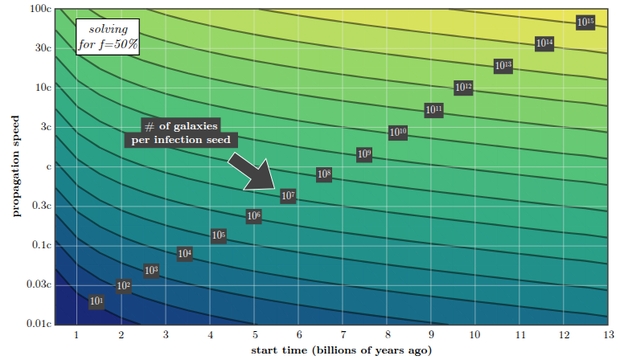
Image: This is Figure 1 from the paper. Caption: A grid of solutions that produce a cosmos precisely half-filled by an infection that has some spontaneous spawn rate within galaxies and then emanates an infection wavefront propagating at a speed given by the y-axis. The x-axis varies the earliest time for which we allow infection seeds to spawn. The contours denote the solved spawn rate to produce half-filling, framed in terms of the mean number of galaxies required to produce one infection seed. Credit: David Kipping.
Why, then, do we not see evidence of this in the night sky? Simply saying that we live in a part of the universe that hasn’t yet been filled seems like extremely wishful thinking. Kipping digs into the anthropic principle, specifically its weak version which suggests that we by necessity live in a part of the universe that is uninfected because otherwise we would not be here to observe.
I lack the ability to present the math involved at this point in the paper (extended into its equation-laden appendix), so I will send those better qualified to the text. Working through models of anthropic reasoning, Kipping finds that it’s possible to construct a universe (or multiverse) in which we observers do not yet detect such an infected cosmos, but note this “important nuance”:
Presumably, the probability of a technological species developing is proportional to the spawn rate of artificial infections. Accordingly, universes with f → 0 may not be so conducive to our emergence after all, since their low spawn rate implies that their intrinsic parameters are tuned to somehow greatly inhibit the development of complex life. This re-framing leans on what is known as the Self Indication Assumption (SIA) in anthropic reasoning (Bostrom 2013).
The paper is arguing that to be consistent with our own existence and observations, the spawn rate (λ) has to be tuned to an extraordinarily small number, ∼10−20 per Gyr per star. Like the cosmological constant, among other parameters, the spawn rate seems to be “enigmatically fine-tuned.” But we needn’t get too far into fine-tuning problems given that models of anthropic reasoning vary, and as the author points out, the definitive theory of anthropic reasoning has yet to be achieved. Which leaves ample scope for the cosmological Hart-Tipler problem to swim into focus as a new problem fit for discussion not only by physicists but philosophers, as surely it will.
Is the possibility of self-replicating probes so far beyond the realm of reality that we can rule them out? Clearly not. It’s interesting to see that even in recent years (and here I’m thinking about a paper Kipping cites, Alex Ellery’s “Self-replicating probes are imminent–implications for SETI” – citation below – which makes the case that self-replication is not far away from the capabilities of our own civilization. Here’s a snip from the abstract of that paper:
We are developing the ability to 3D print entire robotic machines from extraterrestrial resources including electric motors and electronics as part of a general in-situ resource utilization (ISRU) capability. We have 3D-printed electric motors which can be potentially leveraged from extraterrestrial material that should be available in every star system. From a similar range of materials, we have identified a means to 3D print neural network circuitry. From our industrial ecology, self-replicating machines and indeed universal constructors are feasible.
If feasible for us, how much more so for civilizations whose lifetimes take in millions of years? Many of the proposed explanations for the Fermi Paradox have sociological roots that often veer into anthropocentrism. Just how we are to model the ‘ethics’ of extraterrestrials is a worthy question, but explanations moving in this direction and applying to *every* extraterrestrial civilization fail to convince. If self-reproducing probes can be built by even a species not yet at Kardashev Type 1 status, and if we are forced to say that it would only take one in inconceivably vast numbers of stars to produce a builder civilization of these probes, we are left with questions that are more perplexing that ever.
Where are they?
The paper is Kipping, “The Cosmological Hart-Tipler Conjecture,” submitted to Astrobiology (preprint). The Ellery paper I refer to above is “Self-replicating probes are imminent – implications for SETI,” International Journal of Astrobiology, 21(4) (2022), 212–242 (abstract). The Armstrong and Sandberg paper is “Eternity in six hours: Intergalactic spreading of intelligent life and sharpening the Fermi paradox,” Acta Astronautica Volume 89 (August–September 2013), pp. 1-13 (abstract). The Olson paper is “Homogeneous cosmology with aggressively expanding civilizations,” Classical and Quantum Gravity Vol. 32, No. 21 (15 October 2015) 215025 (abstract).

Go to Source
Author: Paul Gilster
SPACEPERIUM CORPS & RESEARCH CONTRIBUTORS
Please comment below with research and links for fellow members to conduct further research into this area.
You must be registered and signed into SPACEPERIUM BLOG in order to leave your comment and get credited!
