
Interstellar Probes: Moving Beyond Bracewell

Lately we’ve been discussing interstellar probes, the kind that an extraterrestrial civilization might use to explore the galaxy. Ronald Bracewell’s analysis of such probes dates back to 1960 and was all but coterminous with the emergence of SETI. The problem with Bracewell probes is that we would expect to have one in our Solar System if they exist. Rather than using that notion to add stress to the Fermi question, I’m going to point out that there is a lot of real estate waiting to be searched.
Case in point: What might our ongoing study of the lunar surface through images from the Lunar Reconnaissance Orbiter pick up as we use AI models that have already identified human-made space debris from various missions? A closer look at this project reminds us that while the Moon is an obvious place to look for a ‘lurker’ probe, we can’t discount other locations even though earlier work on the various Lagrange points, a good place for long-term observation of our planet, came up empty (see below). Our capabilities are so much more advanced not only in terms of instrumentation but analytical tools that a continued hunt for artifacts is reasonable.
I’m getting picky here given the wide variety of possible probes, tapping the definition that Bracewell used in his original article. That’s a probe we probably would have noticed by now if it were active. In 1960, Bracewell was offering an alternative to the SETI goal of detecting an interstellar radio signal aimed at Earth. His physical probe would arrive in a planetary system to look for signs of life and technology, duplicating any radio signals it heard so as to re-transmit them to the originators, thus establishing contact. Sagan uses the notion in his novel Contact (1979), where Adolf Hitler’s opening speech from the 1936 Berlin Olympics is found embedded within the message, along with much else.
How would we respond to hearing a signal sent back to us from space? Bracewell thinks we would experiment with it to see what would happen next:
To notify the probe that we had heard it, we would repeat back to it once a:gain. It would then know that it was in touch with us. After some routine tests to guard against accident, and to test our sensitivity and band-width, it would begin its message, with further occasional interrogation to ensure that it had not set below our horizon. Should we be surprised if the beginning of its message were a television image of a constellation?
Bracewell’s notions of dispatching a physical object as opposed to sending a radio signal take advantage of the ‘information density’ available to a physical probe. This is the familiar notion that a box of DVDs in a truck moves information at a far higher rate than fiber-optic cable. But of course you have to get the truck to its destination, and in the case of interstellar flight the latency is huge – perhaps thousands of years or more. A long-lived civilization, thought Bracewell, may nonetheless see purpose in seeding nearby stars if the travel time is a small fraction of its likely civilizational life.
Swarming and Reproducing
Bracewell’s ideas jibe nicely with the Breakthrough Starshot concept of swarms of sails investigating nearby stars. We might imagine the descendants of such tiny flyby probes scattered to all interesting stellar systems within, say, 100 light years. With concepts like Bracewell’s entering the literature, it was left to Robert Freitas to run the first scientific search I am aware of for such probes (citation below). Freitas made a series of visual observations of the various LaGrange points in the early 1980s. But in the early days of SETI (and Bracewell was writing even before the Green Bank meeting in 1961 that produced the Drake Equation), other ideas about how interstellar probes might operate had begun to surface. Ancient probes sent by civilizations far more advanced than ours might still be live, waiting and reporting on our activities (Clarke’s sentinel ‘slabs’ from 2001: A Space Odyssey come to mind . Or they might be long-dead relics.
Version 1.0.0
When Michael Hart went to work on this in 1975, he amplified the probe concept and changed the game. He produced, in fact, what Jason Wright (Pennsylvania State) has dubbed “The most influential formulation of the Fermi Paradox…,” one that compresses the conundrum by homing in on the fact that we observe no intelligent beings on our planet, something Hart called Fact A. The fact that they are not observed tells us that despite the amount of time available for long-lived cultures to have colonized the galaxy, none evidently have. This is no small problem, for as Wright calculates in his new textbook on SETI, even a ‘wavefront’ of probes moving outwards from star to star at Voyager-like speeds would have been able to reach every star within 2 billion years.
Move the dial up in terms of speed to, say, 0.5 c and the numbers get considerably shortened. Imagine relativistic ships that close on lightspeed and we find exponential growth saturating the galaxy in 150,000 years, all contrasting with an Earth that is 4.5 billion years old. Hart saw nothing in the laws of physics that prohibited starflight, and he found the idea that ETI was uninterested in Earth to be unconvincing. What David Brin coined the ‘Principle of non-Exclusiveness’ boils down to the idea that alien species will not all behave the same way. All that is needed is for one civilization to decide to send out probes, and by now such probes should have reached every star.
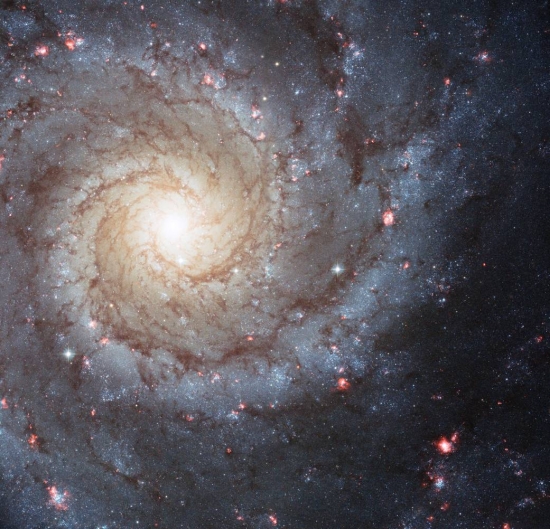
Image: How quickly would a single civilization using self-replicating probes spread through a galaxy like this one (M 74)? Moreover, what sort of factors might govern this ‘percolation’ of intelligence through the spiral? The answers affect our view of the Fermi question, and thus our own place in the cosmos. Image credit: NASA, ESA, and the Hubble Heritage (STScI/AURA)-ESA/Hubble Collaboration.
Advances in computing led Frank Tipler to push Hart’s views even more strenuously, bringing John von Neumann’s work on self-replicating machines to bear. His insight was to ask what would happen if an extraterrestrial culture began seeding stars with self-reproducing probes, each capable of not only studying a new world but building another probe that could reach yet another star, and so on. Here the numbers become even more telling. Such probes could use local resources in each system to build their next generation, thus nullifying the resource problem. Here’s Tipler on the matter:
…if the motivation for communication is to exchange information with another intelligent species, then as Bracewell has pointed out, contact via space probe has several advantages over radio waves. One does not have to guess the frequency used by the other species, for instance. In fact, if the probe has a von Neumann machine payload, then the machine could construct an artifact in the solar system of the species to be contacted, an artifact so noticeable that it could not possibly be overlooked. If nothing else, the machine could construct a “Drink Coca-Cola” sign a thousand miles across and put it in orbit around the planet of the other species. Once the existence of the probe has been noted by the species to be contacted, information exchange can begin in a variety of ways.
As to the cost of such a vast exploration program, Tipler has this to say:
Using a von Neumann machine as a payload obviates the main objection to interstellar probes as a method of contact, namely the expense of putting a probe around each of an enormous number of stars. One need only construct a few probes, enough to make sure that at least one will succeed in making copies of itself in another solar system. Probes will then be sent to the other stars of the galaxy automatically, with no further expense to the original species.
A ‘Catastrophic’ Answer to Fermi?
Tipler suggested a timeframe of 300 million years to fill the galaxy with these devices, in an argument that drew fire from Carl Sagan and William Newman, who argued in 1983 that his approach was ‘solipsistic’ because the idea that we were alone in producing a technological civilization was anti-Copernican. And here we need to pause on a concept that has surfaced repeatedly in SETI studies not just in the western nations but also the Soviet Union. The idea of ‘mediocrity’ troubled attendees at the Soviet SETI meeting at the Byurakan Astrophysical Observatory in 1964, to be discussed again in a second meeting (with American scientists as participants) in 1971.
Do we just take the Copernican principle as a given? Sagan clearly thought so. His ‘co-author’ on Intelligent Life in the Universe, Iosif S. Shklovskii was far less sanguine on the matter:
Since we do not adequately understand the factors leading to the evolution of intelligence and technical civilizations, we cannot reliably estimate the probability that intelligence and technical civilizations will emerge.
Here I’m drawing on Mark Sheridan in his 2023 book SETI’s Scope (How The Search For Extraterrestrial Intelligence Became Disconnected From New Ideas About Extraterrestrials). Sheridan homes in on the philosophical disagreement between emerging Soviet SETI and the ideas in the Drake Equation. At Byurakan, Soviet mathematician A. V. Gladkii challenged the idea, accepted by Sagan, that mathematics could be a recognizable common ground between all intelligences across the stars. And Sheridan quotes Theodosius Dobzhansky, a Ukrainian-born geneticist later working in the U.S., who in a 1972 paper cast doubt on Sagan’s insistence that because intelligence had arisen on our planet, it must arise everywhere life exists. In his view, the principle of mediocrity was being taken several steps too far. Quoting Dobzhansky:
“Natural scientists have been loathe, for at least a century, to assume that there is anything radically unique or special about the planet Earth or about the human species. This is an understandable reaction against the traditional view that Earth, and indeed the whole universe, was created specifically for man. The reaction may have gone too far. It is possible that there is, after all, something unique about man and the planet he inhabits.”
In a fascinating 2009 paper, Milan Ćirković examines the Fermi question in the context of our basic premises about science. As amplified in his later book The Great Silence: Science and Philosophy of Fermi’s Paradox (Oxford University Press, 2018), the Serbian astronomer points to the focus the ‘where are they’ question places upon both Copernicanism and gradualism. In the former, as clearly stated by Sagan as by many other of the early SETI practitioners, the assumption is that we occupy no privileged place in the cosmos, and thus should expect other civilizations to exist, some of which would be far more advanced than ourselves. Yet we do not observe them.

Many answers can be offered to Fermi’s question, of course, but as we continue probing the cosmos, the silence takes on escalating significance. Must we envision a future in which we abandon Copernicanism and assume that we do not, in fact, occupy a relatively common niche in the cosmos, but rather a rather special one?
Or should we give up on gradualism, the idea that geophysical processes proceed in the future more or less as they did in the past? The concept is foundational to 18th Century geology and remains a commonplace in current thinking. But ‘catastrophism’ is an obvious factor in the development of life, as extreme ruptures like the K–T extinction event that ended the era of the dinosaurs make clear. Are there common factors that could affect planets throughout what is thought of as the Milky Way’s habitable zone?
The question is the focus of recent work on gamma ray bursts and implies, as Ćirković notes, a ‘reset’ of the clock. That could explain our lack of detections, as it would imply that living worlds, no matter their geological age, have had only about the same amount of time we have had to develop intelligence. The Fermi question highlights both of these key assumptions, while our lack of a solution keeps the tension tight.
The Bracewell paper is “Communications from Superior Galactic Communities,” Nature Volume 186, Issue 4726 (1960), pp. 670-671. Abstract. On the LaGrange search, see Freitas, “A search for natural or artificial objects located at the Earth-Moon libration points,” Icarus, Volume 42, Issue 3 (June, 1980) p. 442-447 (abstract). Michael Hart’s paper on galactic expansion is “Explanation for the Absence of Extraterrestrials on Earth,” Quarterly Journal of the Royal Astronomical Society, Vol. 16, p.128 (full text). Frank Tipler’s paper on self-reproducing probes is “Explanation for the Absence of Extraterrestrials on Earth,” Royal Astronomical Society, Quarterly Journal, vol. 21 (Sept. 1980), p. 267-281 (full text). Milan Ćirković’s paper on Fermi and Copernicanism is “Fermi’s Paradox – The Last Challenge for Copernicanism?” Serbian Astronomical Journal 178 (2009), 1–20. Preprint.

Go to Source
Author: Paul Gilster
SPACEPERIUM CORPS & RESEARCH CONTRIBUTORS
Please comment below with research and links for fellow members to conduct further research into this area.
You must be registered and signed into SPACEPERIUM BLOG in order to leave your comment and get credited!
