Stability of Interstellar ‘Big Dumb Objects’
‘Big dumb objects’ (BDOs) appear to great effect in science fiction. They come in all manner of sizes and shapes and they fulfill a wide range of functions. An early favorite of mine was Cordwainer Smith’s “Golden the Ships Were Oh! Oh! Oh!,” which I snagged on a long ago trip to a Chicago newsstand, where it appeared in an issue of Amazing Stories. It’s probably found most easily these days in The Rediscovery of Man: The Complete Short Science Fiction of Cordwainer Smith (NESFA Press, 1993), a collection that should be on every science fiction fan’s shelf.
Smith (a pseudonym for Paul Myron Anthony Linebarger, whose life was as remarkable as his fiction) goes to work on structures that are millions of miles long. I won’t say more for fear of spoiling the story for newcomers. More recent BDOs are better known, Dyson spheres and Dyson swarms are no strangers to these pages, and have been the subject of intense scrutiny by Jason Wright and his colleagues at Pennsylvania State University. The G-HAT (Glimpsing Heat from Alien Technologies) project scanned data from the Wide-field Infrared Survey Explorer satellite looking at tens of thousands of galaxies for the waste heat signature of possible Dyson spheres. The idea that megastructures might interest a hugely advanced civilization is reasonable, but we have yet to find evidence that Dyson spheres exist.
Larry Niven’s Ringworld posits a structure that circles an entire star but does not encompass it. A transit signature might give this one away if ever found; imagine the lightcurve. Niven and Gregory Benford later come up with the ‘shipstar’ concept that Greg described some years back on Centauri Dreams. This was an unusual re-thinking of the original ‘Shkadov Thruster,’ a device that could be used to move an entire star. See the Bowl of Heaven trilogy for more.
The work of Russian physicist Leonid Shkadov in 1987, the thruster design used asymmetric light pressure from a huge mirror to move an entire planetary system to a new destination. The physics works, but we’re moving at slow speeds, on the order of 20 meters per second after a million years. On the other hand, a truly long-lived species might find waiting a billion years to reach 20 kilometers per second, with a whopping 34,000 light years shift in position, to be plausible. Shipstar would be able to move considerably faster.
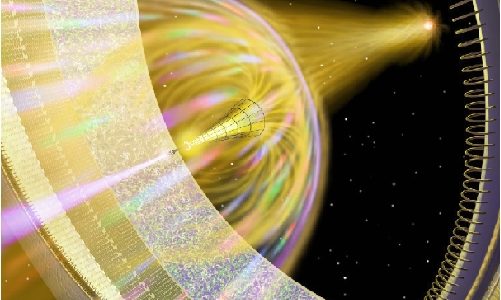
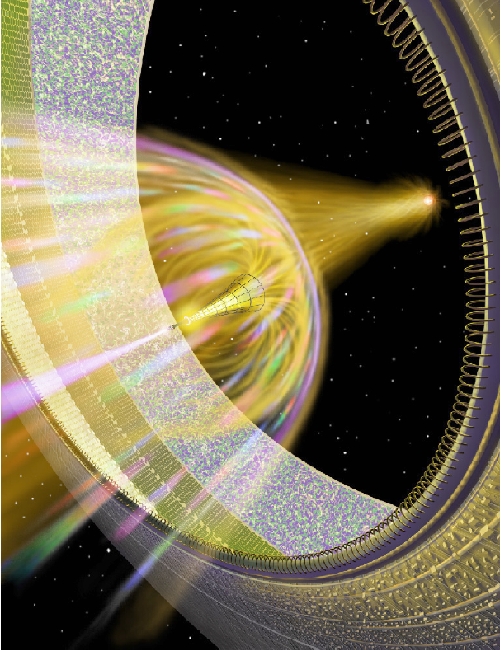
Image: An artist’s conception of the Benford/Niven ‘shipstar’ concept. Think of the ‘bowl’ as half of a Dyson sphere curved around a star whose energies flow into a propulsive plasma jet that moves the entire structure on its journey. Here the notion of living space may remind you of Niven’s Ringworld, that vast structure completely encircling a star, though not enclosing it. The difference is that in the ShipStar scenario, most of the ‘bowl’ is made up of mirrors, with living space just on the rim. Credit: Don Davis.
In conversations with Benford about his shipstar concept a few years ago, I learned that a solid Dyson sphere is unstable, and would need constant adjustment to maintain its position. Concerns over stability plague BDOs. Colin McInnes (University of Glasgow) looks at the problem in a recent paper, noting this about the Shkadov design:
In its simplest form a stellar engine can be considered as a single ideal ultra-large rigid reflective disc in static equilibrium above a central star… As the disc accelerates due to radiation pressure from the star, the centre-of-mass of the gravitationally coupled star-reflector system accelerates, leading to a displacement of the star.
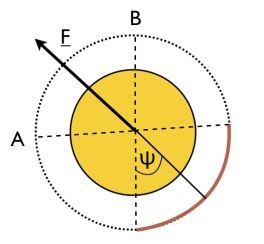
Image: This is Figure 1 from a paper by Duncan Forgan (citation below). Caption: Diagram of a Class A Stellar Engine, or Shkadov thruster. The star is viewed from the pole – the thruster is a spherical arc mirror (solid line), spanning a sector of total angular extent 2ψ. This produces an imbalance in the radiation pressure force produced by the star, resulting in a net thrust in the direction of the arrow. Credit: Duncan Forgan.
That seems straightforward, assuming a civilization so advanced that it could build mirror structures of the needed size. Here too, though, we have stability problems. The McInnes paper is highly interesting, examining megastructure concepts and the possible ways of stabilizing them. While a uniform, rigid reflective disk proves unstable as a star-moving engine, a disk with its mass concentrated at the edges can be stable. Instead of a flat disk, we are looking at something much closer to the shape of a ring. Here passive stability is what we want – i.e., the object does not need continual adjustment by other technologies to maintain its position and function.
In the case of the Schkadov engine, we have this consideration:
…for an ideal reflector subject to gravitational and radiation pressure forces the gradient of these forces across the reflector will induce stresses. While the direction of the radiation pressure force is always normal to the reflector, the direction of the gravitational force will vary across the reflector moving from the centre to the edge. Therefore, while the component of the gravitational force normal to the reflector can in principle be balanced by the radiation pressure force, there will be an in-plane component of the gravitational force which will generate a compressive stress. A thin reflector will clearly be unable to support such compression. However, in principle a zero-stress reflector can be configured for a non-homogeneous, partially reflecting rotating reflector…
The math for a stellar reflector and a stellar ring are laid out in the paper’s appendices.
McInnes thinks that stability is useful as we investigate possible technosignatures in our SETI work, whether they be star-moving thrusters or energy-gathering Dyson objects. The assumption is that passive stability will be sought after because it is efficient and economical, not requiring control systems that must continually adjust position. Remember, too, that in searching for technosignatures, we have the possibility of finding megastructures like these that have survived the demise of their creators. Passive stability is essential for these objects to remain intact and detectable.
What McInnes calls a ‘Dyson bubble’ can likewise be stabilized. Here we’re talking not about a solid Dyson sphere but a constellation of discs, a ‘power swarm’ that allows a civilization to exploit most of the output of its star. The terminology can be confusing but bear with me. The author distinguishes between a cloud of small reflectors in orbit around the central star – huge in number, these form a so-called ‘Dyson swarm’ – and a ‘Dyson bubble,’ by which he means a smaller number of large reflectors in ‘statite’ configuration, so that instead of orbiting, radiation pressure exactly balances gravity. In other words, the ‘bubble’’ components stay stationary relative to the star.
Self-stabilizing techniques are challenged not only by gravitational and radiation pressure but also collisions between the myriad orbiting disks as well as outside perturbing forces. Over large timeframes, passing stars can disrupt the gravitational dance, while interstellar comets, whose numbers are likely to be huge, present a similar risk of disruption. Even so, there are ways around this:
…the Dyson bubble can remain stable when its self-gravity and a simple model of a diffuse background of scattered radiation are included in the dynamics defined in Section 6.4. However, there are now regions of the parameter space where instability can occur, primarily at the edge of the Dyson bubble driven by the diffuse background radiation. In addition, it has been shown that the self-gravity of the Dyson bubble is in itself sufficient to ensure passive stability in the absence of the diffuse background radiation, and indeed it enhances the stability of the Dyson bubble when the diffuse background of scattered radiation is included.
A Dyson swarm if properly implemented can also ensure passive stability. Reflectors must always be configured ‘normal’ (perpendicular) to the central star “…using slighting conical reflectors with the centre-of-pressure displaced behind the centre-of-mass.”
So there are ways of doing these things as long as we abandon the Shkadov concept of a uniform reflector disc in favor of a ring supporting the reflector, or in the case of the two Dyson options McInnes looks at, a dense cloud of reflectors stabilized through orbital mechanics, or a smaller assembly of reflectors in static equilibrium with radiation pressure from the star exactly balancing gravity. But here I’m more interested in the consequences in terms of hunting for technosignatures:
A Dyson swarm can be expected to generate a different technosignature to a passively stable Dyson bubble discussed above. For example, the motion of the discs in a swarm would imply a flickering of the observed luminosity of the central star, with a larger variation expected from a small number of ultra-large discs relative to a large number of small discs. Finally, while an orbiting swarm of reflectors will be susceptible to collisions (B. C. Laki 2025), collisions within a Dyson swarm could in principle be minimised using families of displaced non-Keplerian orbits, where the orbit planes of the reflectors can be stacked in parallel rather than being inclined relative to each other (C. R. McInnes & J. F. L. Simmons 1992).
And what of Shipstar? A recent conversation with Jim Benford reminded me that his brother Greg had worked out a way to stabilize the induced flare on the central star through intense magnetic fields, but as far as I know, this concept has never been rigorously investigated. From the technosignature standpoint, McInnes’ paper reminds us that stability problems can be overcome should an advanced civilization choose to build Dyson-class structures, or undertake star-moving of the Shkadov variety. How to engineer the stability of BDOs should continue to provide insight into possible technosignatures, even if the lack of any trace of Dyson structures despite intensive work at G-HAT remains puzzling. Next week I want to look at an even more recent stellar engine concept as presented by Illinois State University’s Michael Caplan.
The paper is McInnes, “Stellar engines and Dyson bubbles can be stable,” Monthly Notices of the Royal Astronomical Society 546 (2026), 1-18 (full text). The Shkadov paper is “Possibility of Controlling Solar System Motion in the Galaxy,” presented at the 38th Congress of the International Astronautical Federation (IAF) in Brighton, UK. An English translation of the original paper was published in the Journal of Solar System Research Volume 22, Issue 4, pp 210–214 under the title “Possibility of Control of Galactic Motion of the Solar System.” The Forgan paper mentioned above is “On the Possibility of Detecting Class A Stellar Engines Using Exoplanet Transit Curves,” Journal of the British Interplanetary Society, Vol. 66, no. 5/6, 2013 pp. 144–154. Preprint.
Go to Source
Author: Paul Gilster
SPACEPERIUM CORPS & RESEARCH CONTRIBUTORS
Please comment below with research and links for fellow members to conduct further research into this area.
You must be registered and signed into SPACEPERIUM BLOG in order to leave your comment and get credited!
